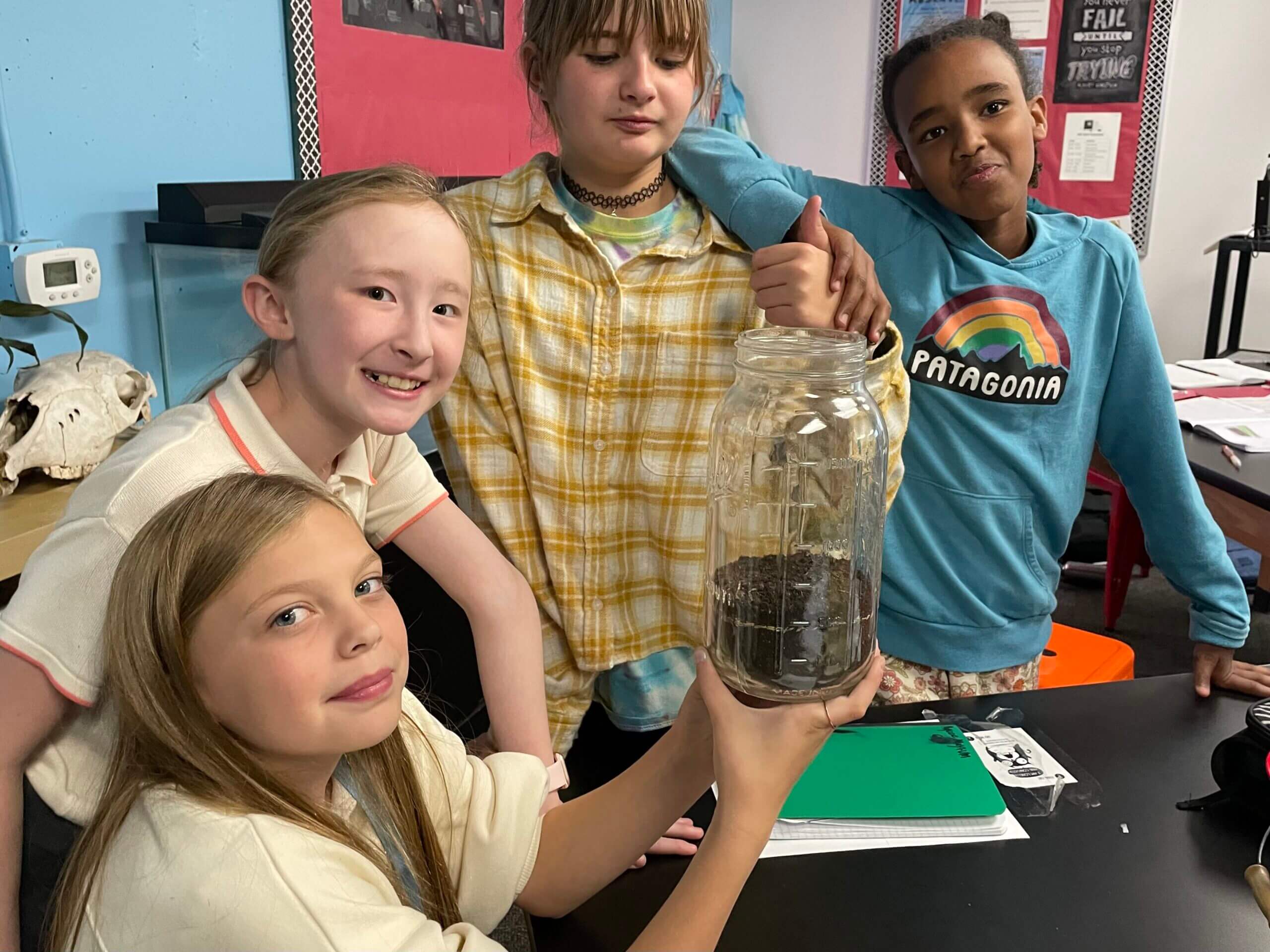
Middle School life science students have gained an appreciation for the complex and fragile systems that make up our world. By creating their own ecosystems in a jar, students have been able to observe the way in which living organisms and nonliving things interact to create a balanced environment. Students started with a large, empty Mason jar and filled the bottom of the jar with about two cups of soil. They added a layer of grass seed, more soil, and an exact measurement of water. They sealed the jars with lids, which they had punched holes in for oxygen, and placed the jars under grow lights. In no time at all, grass began to grow and students could observe ecological processes within the jars.
The idea behind ecosystem jars is that they can sustain themselves without help. This happens when bacteria, algae, and other organisms are allowed to grow, reproduce, and interact, creating an interdependence that promotes life for all. The important comparison, of course, is that our earth is a self-sustaining ecosystem, a community of organisms that depend on each other for survival. By creating their own delicately balanced communities in a jar, students were able to probe the idea of how various physical conditions can affect the greater ecosystem in which they live.